Clean beauty has dominated the conversation around modern skincare for years. But as consumers become more informed, another philosophy is gaining attention: minimal beauty.
There’s a new kind of silence in the beauty world.
No glittering claims. No twenty-step rituals. Just clean lines, calm packaging and words such as “minimal,” “non-toxic” and “skin-barrier safe.”
We are living through what could be called the clean beauty correction, an era in which less appears to promise more. But as “clean” becomes one of the beauty industry’s most frequently used words, an important question remains:
Is clean and minimal beauty a genuine shift in skincare, or simply a new way of marketing restraint?
The answer lies in understanding what these terms actually mean, what they do not mean, and why intentional simplicity is becoming increasingly important to modern skincare.
What Is Clean Beauty?
Clean beauty began as a consumer-driven rebellion.
During the mid-2010s, many consumers became increasingly cautious about ingredients such as parabens and sulphates, while also feeling overwhelmed by long and difficult-to-understand INCI ingredient lists.
Brands responded by removing certain ingredients and making transparency part of their brand proposition. What began as a conscious-consumer movement gradually evolved into an established beauty marketing language.
Sometimes that language represented genuine formulation choices. At other times, it became more about perception than substance.
Editorial note: The original article states that global searches for “clean beauty” increased by more than 300% by 2024. This statistic should be independently verified against the original data source before publication.
The Problem With the Word “Clean”
One of the biggest challenges with clean beauty is that “clean” does not have one universally accepted definition across the beauty industry.
Different brands may establish different ingredient exclusion lists and standards. One brand might describe its approach as being free from a handful of ingredients, while another may exclude dozens or even hundreds.
That creates a problem for consumers.
A product labelled “clean” is not automatically:
- Natural
- More effective
- Better tolerated
- More sustainable
- Free from all synthetic ingredients
- More suitable for every skin type
This is why transparency and formulation philosophy matter more than a single marketing word.
Enter Minimal Beauty
Minimal beauty can be viewed as the younger, calmer sister of clean beauty.
Rather than focusing primarily on what a formula does not contain, minimal beauty focuses on intentional simplicity.
Its philosophy can be summed up simply:
“You don’t need ten products. You need the right three.”
The goal is not necessarily to use fewer ingredients. Instead, it is about creating a skincare routine where every product has a clear purpose.
A well-designed formula may combine multiple skincare functions, such as:
Hydration + protection + radiance
or
Comfort + barrier support + targeted care
This approach can make skincare easier to understand and easier to maintain.
And this is where Orelli Paris fits naturally into the conversation.
Orelli Paris brings together French elegance and next-generation Korean skin science, creating active-led skincare around refined, modern rituals.
The philosophy is simple:
French clarity. Korean science. Skincare, not skin stress.
Clean Beauty vs Minimal Beauty: What Is the Difference?
Although the two concepts often overlap, they are not exactly the same.
| Clean Beauty | Minimal Beauty |
|---|---|
| Focuses on ingredient exclusions and formulation standards | Focuses on intentional simplicity |
| Often asks, “What is left out?” | Often asks, “What is actually necessary?” |
| Can involve specific “free-from” lists | Prioritizes purposeful products and routines |
| May emphasize natural or alternative ingredients | Does not automatically equate simplicity with natural ingredients |
| Can be a brand formulation philosophy or marketing term | Focuses more strongly on reducing unnecessary steps |
The two approaches can coexist, but neither should automatically be treated as a guarantee of efficacy.
The more useful question is:
Does the product have a clear purpose, thoughtfully selected ingredients, appropriate formulation and transparent communication?
The Science of “Clean” vs the Myth
Some of the biggest misconceptions around clean and minimal beauty come from treating marketing categories as scientific definitions.
| Myth | Reality |
|---|---|
| “Clean = Natural” | Not necessarily. Natural ingredients can still cause irritation or sensitivity in some people. |
| “Chemicals are bad.” | Everything is made of chemicals, including water. What matters is the ingredient, concentration, formulation and intended use. |
| “Minimal means less effective.” | A streamlined routine can still contain purposeful active ingredients and provide multiple skincare benefits. |
| “More products mean better skincare.” | More steps do not automatically mean better results. A routine should be appropriate for individual skin needs. |
The important distinction is between ingredient fear and formulation intelligence.
Clean beauty should not mean compromising on efficacy. Instead, the stronger interpretation is about clarity, stability, thoughtful formulation and respect for the skin barrier.
Why Is Minimal Beauty Resonating Now?
Consumers are experiencing what could be described as skincare fatigue.
Every week brings another ingredient, another trend and another multi-step routine.
As the beauty landscape becomes more crowded, many people are beginning to ask different questions:
- Do I really need this product?
- Does this ingredient have a clear purpose?
- Can I simplify my routine?
- Is my skincare routine helping my skin feel balanced?
- Do I understand what I am actually applying?
The emerging beauty mindset can be captured in three simple ideas:
“My skin, but stable.”
“Sustainability, not sensationalism.”
“One product with more purpose.”
Minimal beauty responds to this desire for simplicity.
A more intentional routine can save time, reduce unnecessary product consumption and help consumers understand what actually works for their individual skincare needs.
Most importantly, it can help rebuild trust between consumers and beauty brands.
What Does Clean + Minimal Beauty Look Like in Practice?
The philosophy becomes more meaningful when translated into everyday skincare.
1. Multipurpose Formulas
One of the defining ideas behind minimal beauty is the use of thoughtfully designed formulas that support more than one skincare goal.
Instead of building a routine around numerous products, consumers can look for formulas designed around complementary benefits such as:
- Hydration
- Radiance
- Barrier care
- Smoother-looking skin
- Targeted active care
For example, an active-led cream can become part of a streamlined routine rather than adding several separate products for individual concerns.
Orelli Paris Retinol Collagen represents this active-led approach, combining retinol-focused skincare with collagen and hydrating components as part of a considered evening ritual.
Product-content note: Exact ingredient combinations and percentages should always be taken from the final approved Orelli Paris product packaging/master product data before publication.
2. Ingredient Transparency
Ingredient transparency is increasingly important to informed beauty consumers.
Rather than relying on vague phrases such as “powerful infusion” or “advanced beauty complex,” brands can communicate what their formulas contain and explain the purpose of relevant actives.
This gives consumers more information with which to make their own skincare choices.
Orelli Paris follows an active-led skincare philosophy, with its collection built around purposeful ingredients and clearly defined skincare intentions.
Transparency is not simply about displaying a percentage.
It is also about helping consumers understand:
What is in the formula, why it is there and how it fits into a skincare ritual.
3. Barrier-First Thinking
Minimal beauty prioritizes protection before perfection.
A complicated routine containing multiple powerful actives may not be appropriate for everyone. A more considered approach begins with maintaining comfortable, well-supported skin before continuously adding more products.
This is why hydration and barrier-conscious skincare have become such important parts of modern beauty conversations.
Orelli Paris Hero: PDRN Collagen Jelly Cream
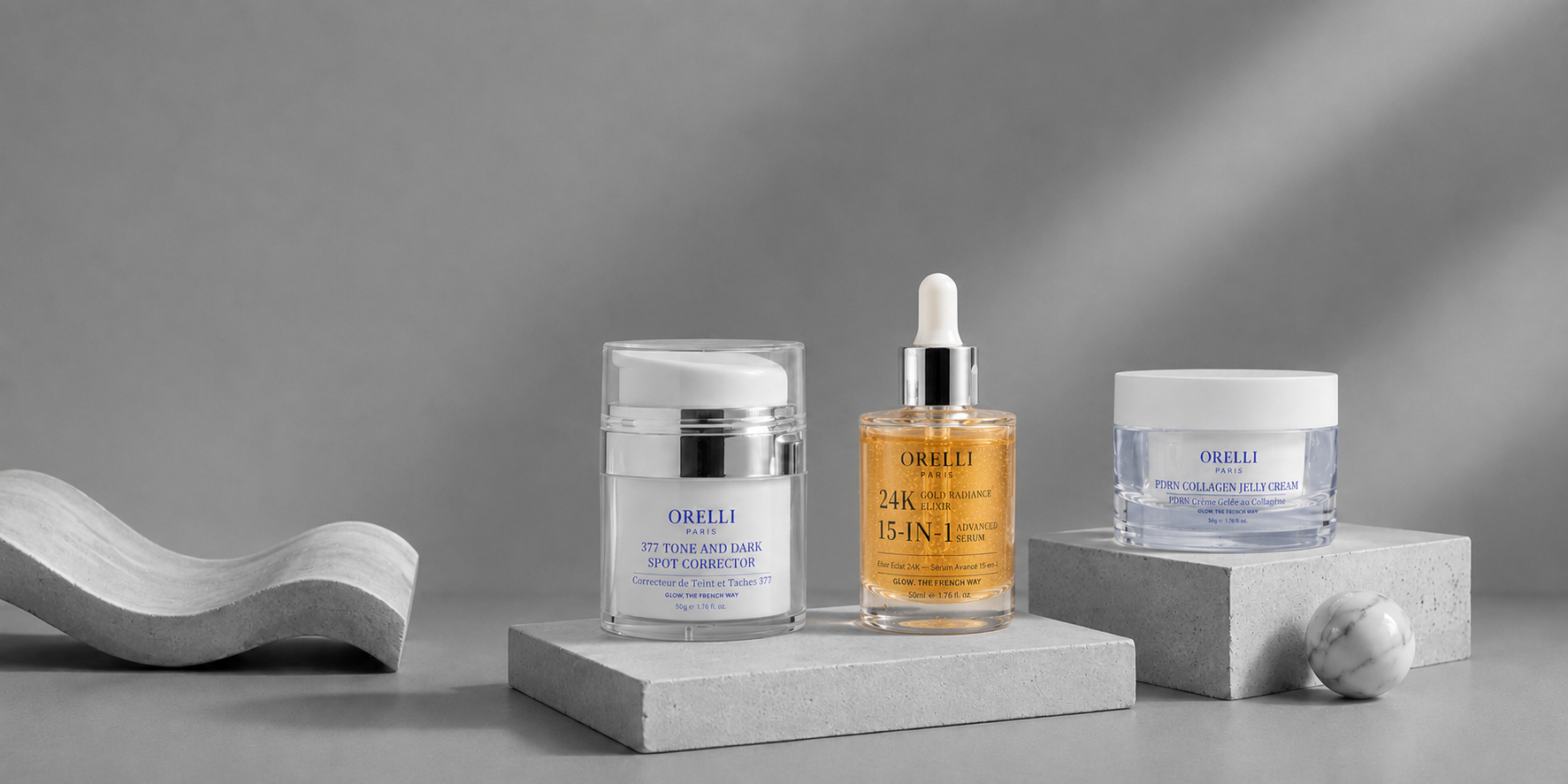
The PDRN Collagen Jelly Cream is designed around hydration and skin comfort, bringing together ingredients such as PDRN, peptides, panthenol and hyaluronic acid.
Its sensorial jelly texture fits naturally into a modern skincare ritual where hydration and comfort are central.
The idea is not to overload the routine.
It is to make each step purposeful.
4. Sustainability Can Be Part of Luxury
Minimal routines can also support a more considered approach to consumption.
Using fewer unnecessary products can potentially mean:
- Less product waste
- Less packaging consumption
- Fewer unused products sitting in a bathroom cabinet
- More intentional purchasing
- Greater appreciation for products that genuinely earn a place in a routine
This connects with a broader evolution in luxury.
Luxury does not always have to mean excess.
It can also mean refinement, restraint, quality and intention.
Clean is therefore becoming less about a label and more about a lifestyle of thoughtful choices.
The New Luxury: Silence
Luxury beauty has traditionally been associated with abundance.
But the language of modern luxury is changing.
Luxury can now be found in the texture of a formula, the honesty of its label, the precision of its formulation and the calm of knowing that your routine contains what you actually need.
This is the philosophy behind:
Glow, The French Way.
For Orelli Paris, radiance is not about adding more noise to skincare.
It is about finding beauty in restraint, refinement and thoughtful formulation.
Less noise.
More nuance.
More purpose.
French Elegance Meets Korean Skin Science
The modern beauty consumer does not necessarily have to choose between sensorial luxury and formulation intelligence.
French beauty has long been associated with elegance, refinement and restraint.
Korean skincare has helped popularize a strong focus on ingredient innovation, layered skin concerns and thoughtful skincare routines.
Orelli Paris brings these influences together through its own interpretation:
French in elegance. Korean in science. Modern in ritual.
The result is an approach to skincare that aims to make active-led beauty feel refined rather than overwhelming.
Clean Beauty’s Next Chapter
Clean beauty 1.0 was largely about avoidance.
Clean beauty 2.0 can be understood as a movement toward intention.
The conversation is shifting from:
“What is this product free from?”
toward:
“What purpose does this product serve?”
This does not mean ingredient exclusions are irrelevant. It means that exclusions alone should not become the entire definition of good skincare.
The next chapter of beauty is likely to place greater emphasis on:
- Ingredient transparency
- Purposeful formulations
- Responsible product development
- Thoughtful active selection
- Skin-barrier awareness
- Sensory experience
- Simpler routines
- More meaningful consumption
In other words:
It is not simply “free from.” It is “full of purpose.”
Clean Beauty vs Marketing Hype: What Should Consumers Look For?
The term “clean” can be attractive, but consumers can look beyond the label.
Before purchasing a product, consider asking:
1. Is the ingredient information clear?
Look for a complete ingredient list and understandable product information.
2. Does the product have a clear purpose?
A product should have a reason for being part of your routine.
3. Are claims specific and understandable?
Be cautious of vague promises that do not explain what the formula actually does.
4. Does the routine need another product?
Minimal beauty is not about refusing additional products. It is about adding them when they serve a genuine purpose.
5. Is the routine appropriate for your skin?
A simple routine can still contain active ingredients. Individual skin needs and tolerability matter.
The goal is not to follow another beauty trend blindly.
The goal is to become a more informed skincare consumer.
Minimal Beauty Does Not Mean Doing Less for Your Skin
There is an important distinction between doing less and doing what matters.
A minimal routine does not have to be an empty routine.
It can still include carefully selected actives, hydration, targeted care and daily sun protection.
For many people, a simple foundation may include:
- Cleanser
- Targeted active or treatment
- Moisturizer
- SPF during the daytime
A serum or mask can then be added when it has a clear role in the routine.
This approach makes skincare more intentional without turning simplicity into another rigid rule.
Orelli Paris and the Philosophy of Meaningful Simplicity
Orelli Paris approaches skincare through a collection of active-led formulas designed around different skin intentions.
From radiance and tone refinement to hydration, barrier comfort and smoother-looking skin, each formula has a defined place within a modern skincare ritual.
The philosophy is not about owning every product.
It is about understanding what your skin needs and choosing products accordingly.
That is where minimal beauty becomes more than a trend.
It becomes a way of thinking about skincare.
A Simple Orelli Paris-Inspired Ritual
Minimal does not mean less care.
It means better choices.
A routine can begin with the PDRN Collagen Jelly Cream when hydration and skin comfort are the priority, incorporate the Vitamin C Niacinamide Cream as part of a radiance-focused routine, and use the PDRN BIO Collagen X Pink Vita Repair Mask as an occasional treatment step.
The idea is not to use everything at once.
It is to create a routine where every product has a purpose.
Real minimal beauty is science made simple.
Glow, The French Way. 🇫🇷✨
Frequently Asked Questions
What is the difference between clean beauty and minimal beauty?
Clean beauty generally focuses on ingredient exclusions or specific formulation standards, while minimal beauty focuses on intentional simplicity and avoiding unnecessary steps. The two approaches can overlap, but they are not identical.
Are synthetic ingredients bad for your skin?
Not necessarily. An ingredient’s being synthetic does not automatically make it harmful or ineffective. Ingredient safety, formulation, concentration and individual skin tolerance are more meaningful considerations than simply whether an ingredient is natural or synthetic.
Can a minimal skincare routine work for different skin types?
A simplified routine can be adapted to different skin types and concerns. However, there is no single routine that is appropriate for everyone. Product selection should reflect individual skin needs and tolerance.
How many skincare products do I really need?
There is no universal number. A basic routine can often be built around cleansing, moisturizing and daytime sun protection, with targeted treatments or masks added when they serve a specific purpose.
Is clean beauty just marketing?
The term can be used differently by different brands, so consumers should look beyond the word “clean.” Ingredient transparency, clear product information, formulation purpose and substantiated claims provide more useful context.
Does minimal beauty mean using fewer ingredients?
Not necessarily. Minimal beauty is primarily about purposeful routines and reducing unnecessary steps, rather than automatically reducing the number of ingredients in every formula.
Is minimal skincare better than a multi-step routine?
There is no universal answer. Some people prefer a simple routine, while others may have specific skincare needs requiring additional products. The key principle is that every step should have a clear purpose.