
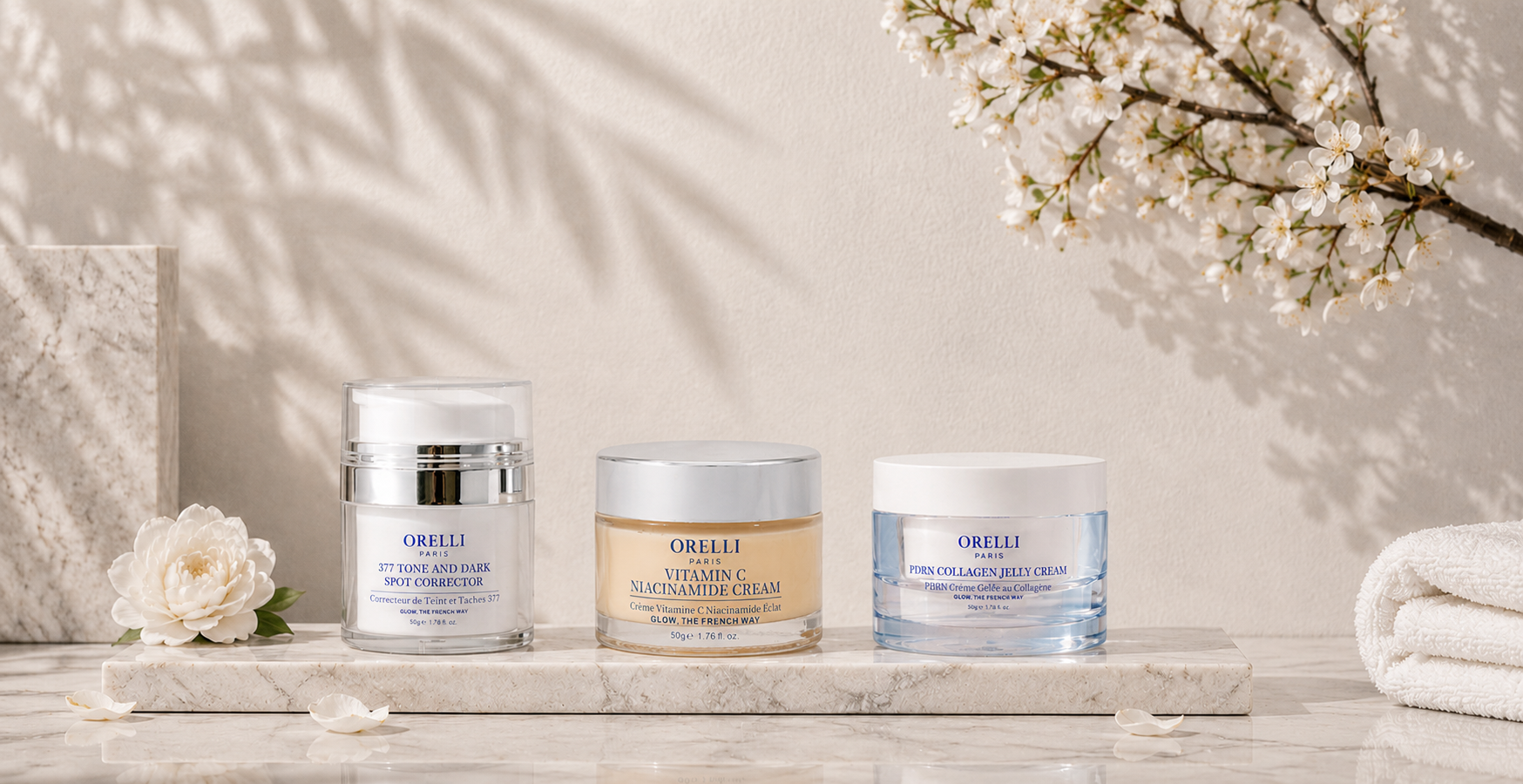
Acne-prone skin doesn’t necessarily need a complicated routine. In many cases, the better approach is to keep your skincare gentle, consistent and purposeful.
Cleansing helps remove excess oil and buildup. Targeted actives can address specific concerns such as breakouts, uneven-looking tone and post-blemish marks. Moisturizer helps maintain skin comfort, while daily sunscreen helps protect against UV-related pigmentation.
The American Academy of Dermatology recommends gentle skincare for acne-prone skin and advises avoiding habits that irritate the skin, such as aggressive scrubbing. It also recommends looking for products labelled oil-free, non-comedogenic or “won’t clog pores.”
At Orelli Paris, this philosophy fits naturally with a simple, active-led approach to modern skincare: smarter formulas, fewer unnecessary steps and a refined daily ritual.
What Does Acne-Prone Skin Need?
Acne can involve clogged pores, excess oil, inflammation and changes in the skin environment. The right routine should therefore focus on supporting the skin rather than stripping it.
A practical acne-friendly routine generally includes:
- A gentle cleanser
- Targeted treatment ingredients
- A lightweight moisturizer
- Broad-spectrum sunscreen
- Consistency rather than excessive product layering
For persistent, painful or severe acne, skincare products alone may not be enough. A dermatologist can diagnose the type of acne and recommend appropriate treatment.
The AAD’s acne guidelines include topical retinoids and benzoyl peroxide among evidence-based acne treatments.
Step 1: Cleanse Gently
Morning and Evening
Cleansing is the foundation of an acne skincare routine.
The goal isn’t to make your skin feel extremely tight or “squeaky clean.” Overly aggressive cleansing can irritate the skin, and dermatologists recommend a gentle approach for acne-prone skin.
Look for:
- Gentle cleansing agents
- Skin-friendly formulas
- Products appropriate for oily or combination skin
- Oil-free or non-comedogenic options where appropriate
If you’re removing sunscreen or makeup at night, a carefully chosen first cleanse followed by a gentle cleanser can be useful, particularly when your skin tolerates the routine well.
Avoid:
- Harsh physical scrubs
- Excessive cleansing
- Very hot water
- Aggressive rubbing
The Orelli approach: Cleanse without turning cleansing into a battle with your skin.
Step 2: Add a Targeted Treatment
Once skin is clean, the next step depends on your primary concern.
Acne-prone skin can have different needs. Someone dealing mainly with active breakouts may need a different treatment strategy from someone whose main concern is post-blemish marks or uneven-looking tone.
This is where ingredients such as niacinamide, salicylic acid, vitamin C and retinoids can have different roles.
However, more actives do not automatically mean better skincare.
Introduce new active ingredients gradually and avoid overwhelming sensitive skin with several strong treatments at once.
Step 3: Niacinamide for Acne-Prone Skin
Niacinamide, also known as vitamin B3, is widely used in skincare for its role in supporting the skin barrier and improving the appearance of uneven tone and texture.
Orelli Paris includes Niacinamide among its highlighted skincare ingredients and uses it across its active-led collection.
For acne-prone skin, the goal should be balance rather than aggressive oil stripping.
If your skin is sensitive, start with a formula your skin tolerates well and introduce new actives one at a time.
Step 4: Vitamin C for Post-Blemish Marks
If breakouts have left behind dark-looking marks or uneven tone, your routine may need to address the appearance of pigmentation as well as current breakouts.
Vitamin C is commonly used in skincare for brightening and antioxidant support. The American Academy of Dermatology notes that vitamin C can help address dark spots and recommends applying it after cleansing in the morning, before sunscreen.
Orelli Paris Vitamin C Niacinamide Cream
The Vitamin C Niacinamide Cream is positioned by Orelli Paris as a daily radiance-enhancing moisturizer for brightening, tone correction and hydration.
Its current product page highlights:
- Vitamin C
- Niacinamide
- Alpha Arbutin
- Vitamin E
- Hyaluronic Acid
The page also lists Acne Marks & Breakouts among its product categories and states that the formula is suitable for all skin types.
How to use it
Apply to clean skin in the morning and follow with sunscreen.
If your skin is sensitive, patch test first and introduce the product gradually.
Step 5: Choose an Acne-Friendly Moisturizer
One of the most common misconceptions about oily or acne-prone skin is that moisturizer should be avoided.
That’s not necessarily true.
The American Academy of Dermatology recommends moisturizer for people with acne when their skin is dry and suggests looking for oil-free, non-comedogenic or “won’t clog pores” products.
A lightweight moisturizer can help make a routine more comfortable, particularly when you’re using potentially drying acne treatments.
Step 6: PDRN Collagen Jelly Cream for Hydration
The PDRN Collagen Jelly Cream is part of the Orelli Paris collection and sits within the brand’s hydration and barrier-support approach. Orelli Paris describes the collection as active-led formulas designed around specific skin intentions including hydration and barrier comfort.
Its highlighted ingredients include:
- PDRN
- Peptides
- Panthenol
- Hyaluronic Acid
Its jelly texture makes it a natural option for a hydration-focused skincare ritual.
For acne-prone skin, however, don’t assume that every moisturizer is automatically non-comedogenic. Check the individual product label and how your own skin responds.
Step 7: Retinoids and Acne-Prone Skin
Retinoids are among the most established topical treatments for acne.
The American Academy of Dermatology’s acne guidelines strongly recommend topical retinoids such as adapalene, tretinoin, tazarotene and trifarotene for acne treatment.
It’s important to distinguish these medical acne treatments from cosmetic retinol products.
Retinol vs. Prescription Retinoids
Retinol is a type of vitamin A derivative used in cosmetic skincare. Prescription retinoids such as tretinoin and adapalene have different formulations, strengths and indications.
The AAD notes that retinoids can help with mild acne and uneven pigmentation, but they can also cause irritation, particularly when introduced too quickly.
Orelli Paris Retinol Collagen
Retinol Collagen is one of Orelli Paris’s six active-led formulas and is positioned around smoother-looking texture and visible renewal.
Orelli’s own educational material recommends introducing retinol gradually and using it at night, with sun protection during the day.
A simple approach
If you’re new to retinol:
- Start slowly.
- Apply at night.
- Avoid combining it with multiple strong exfoliating treatments initially.
- Use moisturizer to support comfort.
- Wear sunscreen during the day.
Important: Retinoids and retinol are not appropriate for everyone. If you’re pregnant or trying to become pregnant, discuss vitamin A-based skincare with your healthcare professional before use. The AAD advises against retinoid use during pregnancy.
Step 8: Don’t Forget Sunscreen
Sunscreen is particularly important when you’re concerned about post-acne marks.
UV exposure can worsen pigmentation and some acne treatments can increase sun sensitivity.
The American Academy of Dermatology recommends a broad-spectrum, water-resistant sunscreen with SPF 30 or higher and suggests choosing a non-comedogenic option for acne-prone skin.
Your morning order
Cleanse → Treatment → Moisturizer → Sunscreen
If your moisturizer already contains sunscreen, check whether it provides adequate broad-spectrum protection and use it according to the label.
Step 9: Give Your Skin Recovery Days
Acne-prone skin doesn’t need every active ingredient every day.
If your routine contains retinol, acids or other potentially irritating ingredients, consider simplifying the routine when your skin feels dry, tight, uncomfortable or irritated.
A recovery-focused routine can be as simple as:
Cleanse → Hydrate → Moisturize → Sunscreen in the morning
This is consistent with Orelli Paris’s broader philosophy of purposeful routines rather than unnecessary complexity.
A Simple 24-Hour Acne-Prone Skin Routine
| Time | Step | Purpose | Orelli Paris Option |
|---|---|---|---|
| AM | Cleanse | Remove overnight buildup | Gentle cleanser |
| Treat | Radiance + tone support | Vitamin C Niacinamide Cream | |
| Moisturize | Hydration + comfort | PDRN Collagen Jelly Cream, if needed | |
| Protect | UV protection | Broad-spectrum SPF 30+ | |
| PM | Cleanse | Remove sunscreen and buildup | Gentle cleanser |
| Treat | Targeted renewal | Retinol Collagen, as tolerated | |
| Moisturize | Hydration + comfort | PDRN Collagen Jelly Cream | |
| Weekly | Treatment | Additional care | PDRN BIO Collagen X Pink Vita Repair Mask, according to product directions |
This is a cosmetic skincare routine, not an acne-treatment protocol. If you’re treating persistent or moderate-to-severe acne, follow your dermatologist’s treatment plan rather than replacing prescribed treatment with cosmetic skincare.
Where Does the PDRN BIO Collagen X Pink Vita Repair Mask Fit?
The PDRN BIO Collagen X Pink Vita Repair Mask is one of Orelli Paris’s six active-led formulas. The collection positions it around hydration, comfort and a replenishing ritual.
Its highlighted ingredients include:
PDRN + Collagen + Niacinamide + Peptides + Hyaluronic Acid
Use it as an occasional treatment step according to the product’s directions rather than treating it as a replacement for an acne medication.
Common Acne Skincare Mistakes
1. Washing Your Face Too Aggressively
Problem: Excessive cleansing can irritate the skin.
Better approach: Use a gentle cleanser and avoid aggressive scrubbing.
2. Skipping Moisturizer
Problem: Acne treatments can leave skin dry or uncomfortable.
Better approach: Consider an oil-free or non-comedogenic moisturizer appropriate for your skin.
3. Starting Multiple Actives at Once
Problem: It becomes difficult to identify what is causing irritation.
Better approach: Introduce one new active at a time.
4. Forgetting Sunscreen
Problem: UV exposure can contribute to persistent pigmentation.
Better approach: Use broad-spectrum SPF 30+ and choose a non-comedogenic formula if you have acne-prone skin.
5. Picking or Popping Breakouts
Problem: Manipulating acne can irritate the skin and increase the risk of marks and scarring.
Better approach: Leave active lesions alone and seek professional guidance when acne is persistent or severe.
Can Orelli Paris Products Be Part of an Acne-Prone Skin Routine?
They can be incorporated into a cosmetic skincare routine, particularly when the goal is to support hydration, tone and overall skin appearance.
The current Orelli Paris collection includes six active-led formulas:
- 24K Gold Radiance Elixir 15-IN-1 Advanced Serum
- 377 Tone And Dark Spot Corrector
- PDRN Collagen Jelly Cream
- PDRN BIO Collagen X Pink Vita Repair Mask
- Retinol Collagen
- Vitamin C Niacinamide Cream
Orelli Paris describes these formulas around different skin intentions including radiance, tone refinement, hydration, barrier comfort, smoother-looking texture and visible renewal.
For acne-prone skin, however, product selection should depend on your individual skin condition and tolerance rather than simply choosing the maximum number of active ingredients.
How to Build a Simpler Acne Skincare Routine
You don’t need six products to create a good routine.
Start with four essentials:
Morning
1. Cleanse
↓
2. Targeted treatment
↓
3. Moisturize if needed
↓
4. Broad-spectrum SPF 30+
Evening
1. Cleanse
↓
2. Targeted treatment
↓
3. Moisturize
Then introduce additional products only when you understand what your skin needs.
That is very close to the Orelli Paris philosophy:
Smarter formulas. Fewer steps.
Frequently Asked Questions
Is retinol good for acne-prone skin?
Retinol can be useful for some people, particularly for mild acne-related concerns, texture and pigmentation. However, cosmetic retinol is different from prescription retinoids used specifically to treat acne. If acne is persistent or moderate-to-severe, consult a dermatologist.
Should I moisturize if I have oily acne-prone skin?
Yes. Acne-prone skin can still become dry or irritated. Look for an oil-free or non-comedogenic moisturizer and choose a formula your skin tolerates well.
Can I use Vitamin C if I have acne-prone skin?
Vitamin C is commonly used for antioxidant support and the appearance of dark spots. Orelli Paris’s Vitamin C Niacinamide Cream is positioned for brightening, tone correction and hydration, and its product page specifically includes acne marks and breakouts among its categories.
Is niacinamide good for acne-prone skin?
Niacinamide is a versatile skincare ingredient used to support the skin barrier and improve the appearance of tone and texture. Orelli Paris includes niacinamide among its highlighted ingredients.
How long does it take to improve acne?
There is no single timeline that applies to everyone. Acne treatment can take time, and results depend on the type and severity of acne and the treatment being used. If breakouts continue despite a consistent routine, consult a dermatologist.
What sunscreen is best for acne-prone skin?
Look for a broad-spectrum, water-resistant SPF 30 or higher and, if you’re prone to clogged pores, choose a product labelled non-comedogenic or won’t clog pores.
Can I use retinol and Vitamin C together?
They can be incorporated into the same overall routine, but using them at different times can make the routine easier to tolerate. Orelli Paris’s Vitamin C Niacinamide Cream page specifically suggests Vitamin C in the morning and retinol at night.
When Should You See a Dermatologist?
Skincare can support your routine, but it isn’t a substitute for medical acne treatment.
Consider seeing a dermatologist if you have:
- Painful or deep breakouts
- Significant inflammation
- Acne that is leaving scars
- Persistent acne despite consistent skincare
- Sudden or unusual breakouts
- Acne that is affecting your confidence or quality of life
The AAD notes that a dermatologist can determine the type of acne and recommend an appropriate treatment plan.
Final Takeaway
Acne-prone skin doesn’t need punishment. It needs a thoughtful routine.
Start gently.
Choose targeted actives based on your skin’s needs.
Keep hydration in the routine.
Protect your skin from the sun.
And introduce new products gradually.
Orelli Paris approaches skincare through French elegance, next-generation Korean skin science and modern rituals, with active-led formulas designed around specific skin intentions.
The goal isn’t to overwhelm your skin.
It’s to create a ritual you can understand, enjoy and stay consistent with.