
It’s one of skincare’s most searched questions — and for good reason.
After acne heals, it often leaves something behind: dark marks, uneven tone, or lingering pigmentation.
Enter Vitamin C — the internet’s favorite “brightening miracle.”
But does it really fade acne scars, or is it just another marketing myth bottled in orange packaging?
Let’s separate science from skincare wishful thinking and uncover the truth about how Vitamin C works — and how to use it effectively for real, visible clarity.
First, Let’s Clarify: What Are Acne Scars Really?
The word “scar” often gets misused.
There are two main types of post-acne marks:
| Type | Description | Example |
| Post-Inflammatory Hyperpigmentation (PIH) | Flat dark or red marks left after pimples heal | Brown or pink spots that fade slowly |
| Atrophic Scars | Textural dents caused by collagen loss | Ice-pick or rolling scars |
Vitamin C can’t fill deep textural scars — that requires professional treatments (microneedling, laser).
But for PIH and discoloration, Vitamin C is one of the most researched and effective topical treatments available.
The Science: How Vitamin C Fades Pigmentation
Vitamin C (ascorbic acid and its stable forms like Ethyl Ascorbic Acid) works by interrupting melanin synthesis, the process that creates pigment in your skin.
Here’s how:
1️. Inhibits Tyrosinase — an enzyme that triggers melanin production.
2. Neutralizes free radicals — reducing inflammation and UV damage that worsen spots.
3️. Boosts collagen synthesis — improving skin texture and resilience.
4️. Promotes cell turnover — gradually revealing clearer skin underneath.
In clinical studies, stabilized Vitamin C (10–20 %) showed visible fading of post-acne marks in as little as 8 weeks, with continued improvement up to 16 weeks.
That’s not hype — that’s data.
Why It Works Best in Combination
While Vitamin C is powerful on its own, pairing it with complementary actives enhances its effects dramatically.
Niacinamide (Vitamin B3) — The Calm Brightener
Niacinamide reduces inflammation and blocks pigment transfer from melanocytes to skin cells.
Together, Vitamin C + Niacinamide brighten faster and soothe better — a dream duo for acne-prone or sensitive skin.
Arbutin — The Gentle Fader
Arbutin works on surface pigmentation by slowing melanin release, complementing Vitamin C’s deeper action.
Hyaluronic Acid + Vitamin E — The Protectors
Hydration and antioxidants strengthen the barrier, preventing irritation that could trigger new spots.
The Smart Way to Use Vitamin C for Acne Scars
The key to Vitamin C success isn’t strength — it’s stability and consistency.
Here’s your dermatologist-approved routine:
Morning Routine
1️. Cleanse gently to remove oil buildup.
2️. Apply Vitamin C serum or cream on clean, dry skin.
3️. Wait 1–2 minutes, then layer your moisturizer.
4️. Finish with SPF 30 + — always.
Evening Routine
Use hydrating, barrier-repair actives like Niacinamide, Panthenol, or PDRN to support recovery overnight.
The “Wrong” Way (That Causes Irritation)
- Mixing Vitamin C with strong acids (AHA/BHA)
- Skipping sunscreen
- Using unstable Vitamin C (oxidized or orange in color)
- Starting at too high a concentration for sensitive skin
Healthy brightening comes from patience, not potency.
The Modern Answer: Stabilized, Synergistic Formulas
Meet the science-backed evolution of Vitamin C skincare:
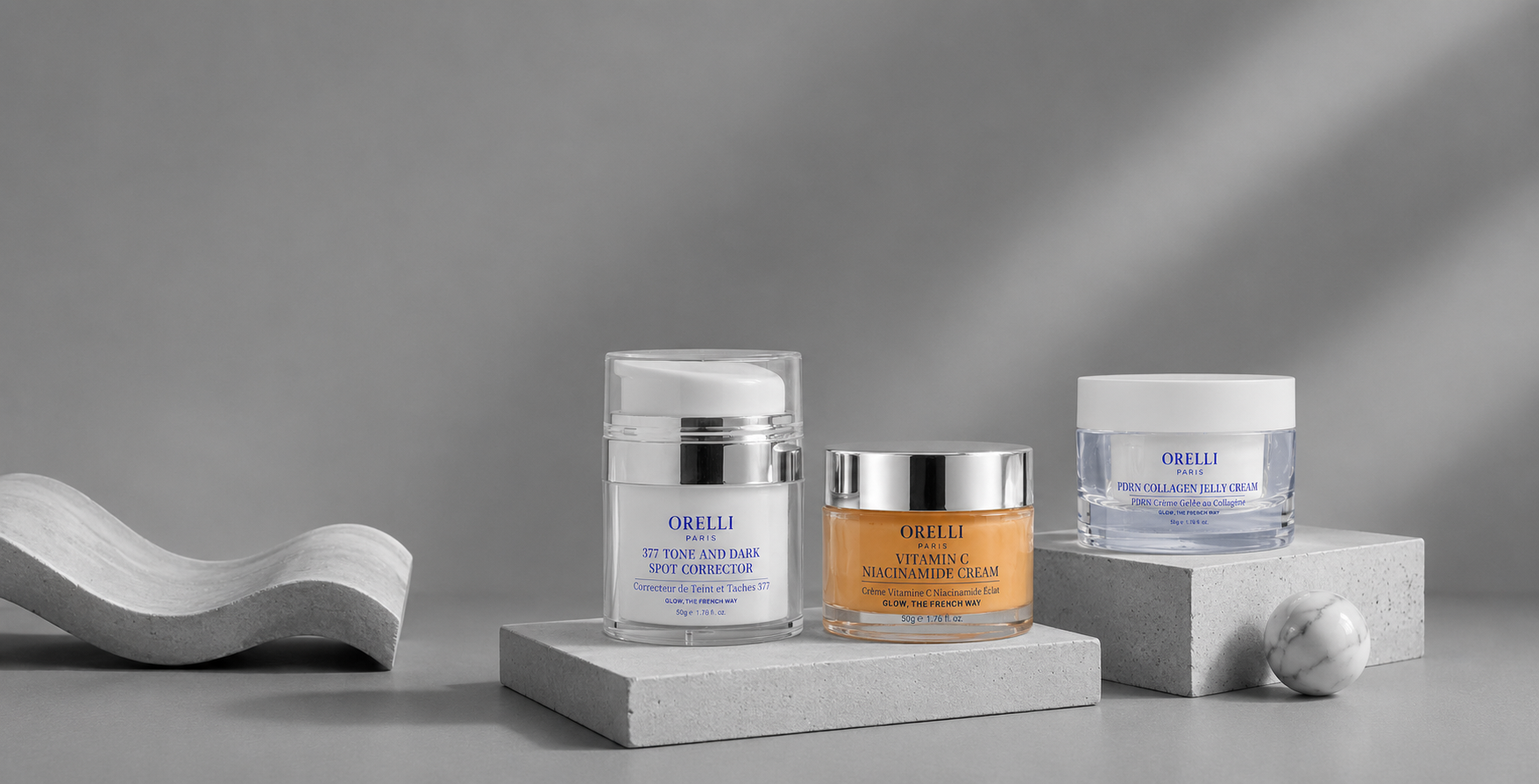
Orelli Paris Vitamin C + Niacinamide Radiance Cream
10 % Ethyl Ascorbic Acid (Vitamin C) + 5 % Niacinamide + 2 % Arbutin + 1 % Hyaluronic Acid + 1 % Vitamin E
| Feature | Why It Matters |
| Dual Brightening System | Vitamin C + Niacinamide work in synergy for faster fading of dark marks |
| Barrier-Friendly Texture | Lightweight cream cushions sensitive or post-acne skin |
| Long-Term Stability | Encapsulated Vitamin C resists oxidation |
| Dermatologically Tested | Safe for daily AM & PM use |
Result: brighter tone, smoother surface, and calmer post-breakout skin — the French way.
Timeline: When You’ll See Results
| Week | What Happens |
| 1–2 | Brighter tone, mild glow |
| 3–4 | Visible lightening of new spots |
| 6–8 | Older pigmentation starts fading |
| 12 + | Even tone, smooth, healthy radiance |
Consistency is your glow secret — not high percentages.
Pair It for Maximum Clarity
| Routine Step | Product | Purpose |
| AM: Cleanse → Radiance Cream → SPF | Brightening & protection | |
| PM: Zero Pore Pads → Collagen Jelly Cream (PDRN DNA Repair) | Exfoliate + repair | |
| Weekly: PRDN BIO Collagen X™ Mask | Deep hydration & recovery |
⚠️ Common Myths About Vitamin C and Acne Scars
| Myth | Truth |
| “Vitamin C makes skin peel.” | Only unstable, overly acidic formulas do. Stable forms gently renew. |
| “You can’t use Vitamin C with Niacinamide.” | Old myth. Modern formulations are perfectly compatible. |
| “It only works on new scars.” | It lightens both new and old pigmentation with consistent use. |
| “It’s too strong for sensitive skin.” | Encapsulated, pH-balanced Vitamin C = safe radiance. |
Internal-Link Paragraph (Orelli Paris Tone – Editorial & Organic)
Clarity isn’t chemistry — it’s balance.
For fading acne scars gently, start your morning with the Vitamin C + Niacinamide Radiance Cream, and pair it at night with the Collagen Jelly Cream (PDRN DNA Repair) for hydration and repair.
Twice a week, reset your skin with the PRDN BIO Collagen X™ Pink Vita Repair Mask.
Fade spots, not confidence — Glow, the French Way.
FAQ
Q1: How long does it take for Vitamin C to fade acne marks?
Expect visible improvement in 4–8 weeks with daily use and SPF protection.
Q2: Can I use Vitamin C if I still get breakouts?
Yes. It reduces post-inflammatory pigmentation and helps calm redness.
Q3: What strength of Vitamin C is best for acne marks?
10 – 15 % is ideal — high enough for results, low enough for comfort.
Q4: Should I use it day or night?
Morning is ideal for antioxidant protection; evening works too for repair — consistency matters more than timing.
Q5: Can Vitamin C completely remove scars?
It fades pigmentation but cannot fill indented scars. For those, pair with professional treatments.