
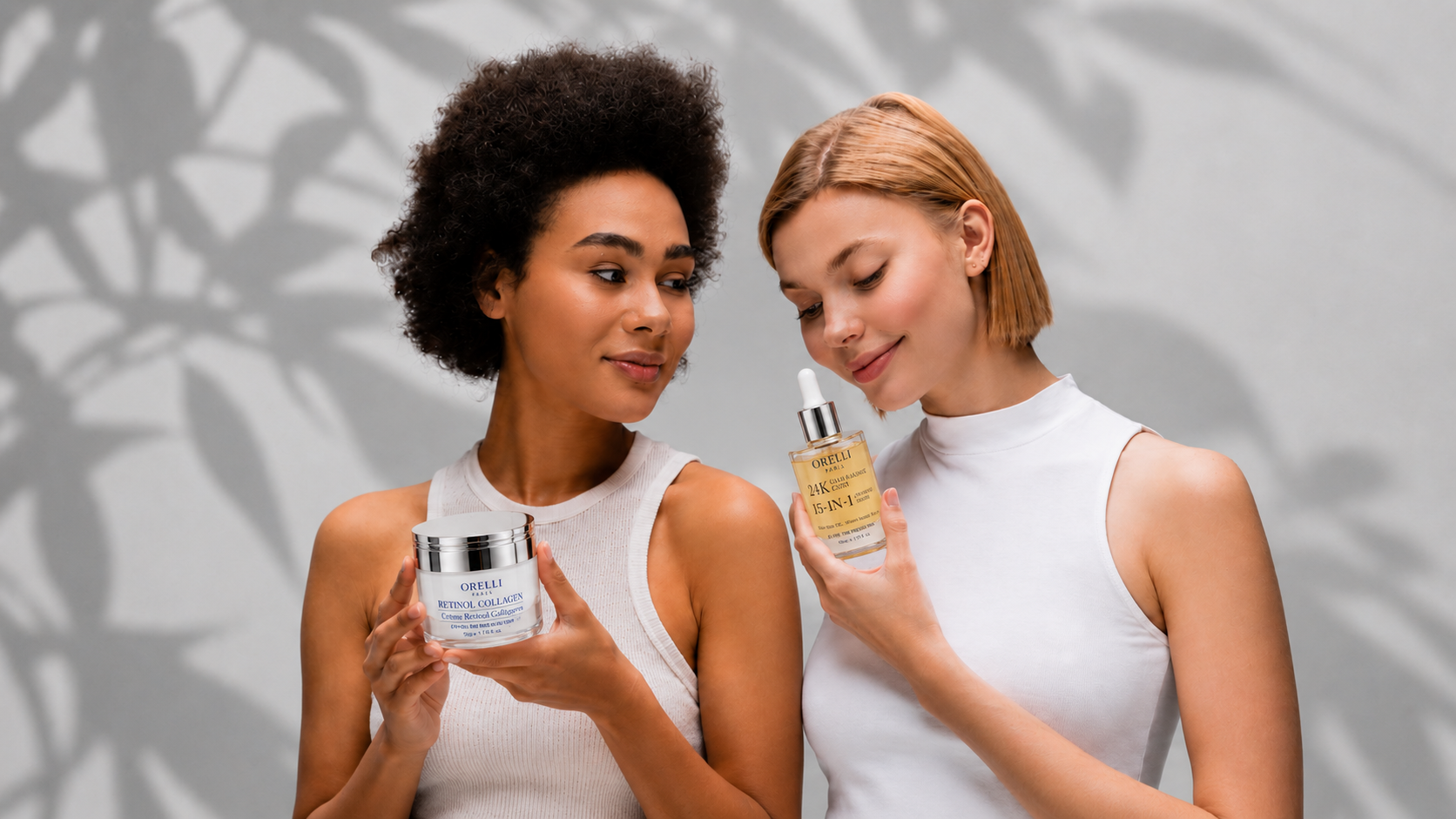
You’ve seen it all over social media — that mirror-like glow that seems to radiate from within.
It’s called Glass Skin, and it’s more than just a trend.
Born from K-beauty philosophy and perfected by science, glass skin reflects clarity, hydration, and barrier health — not just shine.
But is it achievable without filters and facials?
And more importantly, is chasing that glow actually good for your skin?
Let’s break down what glass skin really is, how to achieve it safely, and whether this viral ideal still holds up in 2025’s smarter skincare era.
What “Glass Skin” Really Means
Contrary to what Instagram suggests, glass skin isn’t about being oily or glazed — it’s about healthy translucence.
The term originated in South Korea, where the ideal complexion looked like “glass”:
smooth, poreless, hydrated, and light-reflective — a reflection of balance, not just brightness.
True glass skin doesn’t come from highlighter.
It comes from moisture, structure, and a strong barrier.
The Science Behind the Glow
Glass skin is the visible result of three biological factors working in sync:
| Factor | What It Does | Result |
| Hydration | Keeps cells plump and light-reflective | Dewy bounce |
| Barrier Strength | Prevents moisture loss and irritation | Smoothness |
| Cell Turnover | Removes dull surface cells | Clarity and glow |
The glow is not makeup — it’s the optical effect of light bouncing off hydrated, even skin.
Step-by-Step: How to Get Glass Skin (the Smart Way)
Forget 10-step routines and product overload.
Modern glass skin is about layering intelligently — minimal, functional, and science-backed.
Step 1: Gentle Cleanse — Never Strip
Cleansing is where glow begins.
Avoid harsh foaming cleansers that leave your skin “squeaky clean” — that squeak means your barrier is gone.
Use: a pH-balanced, hydrating cleanser with amino acids or mild surfactants.
Follow with lukewarm water — hot water dehydrates.
Step 2: Exfoliate (Gently and Consistently)
Glass skin depends on smooth surface texture — but harsh exfoliation kills the glow.
Opt for PHA or enzyme exfoliation instead of high-strength acids.
They remove dead cells without disrupting the barrier.
Orelli Paris Pair:
Zero Pore Pads — infused with PHA, Niacinamide, and PDRN DNA to gently renew texture while hydrating deeply.
✅ Use 2–4 times a week after cleansing.
Step 3: Quench — Hydration Is the Core
If glass skin had one commandment, it would be: Hydrate, don’t suffocate.
Layer lightweight humectants like Hyaluronic Acid, Panthenol, and Beta-Glucan.
They draw water into the skin’s upper layers, making it look bouncy and lit-from-within.
Orelli Paris Pair:
Collagen Jelly Cream (PDRN DNA Repair) — a jelly-cream hybrid that locks in hydration while repairing the barrier.
The cooling texture gives that instant “glass” finish — but it’s skin health beneath the shine.
Step 4: Brighten — Add Controlled Radiance
A real glow isn’t about shimmer; it’s about even tone.
Ingredients like Vitamin C, Niacinamide, and Arbutin target uneven patches and boost radiance naturally.
Orelli Paris Pair:
Vitamin C + Niacinamide Radiance Cream — combines stabilized 10% Vitamin C with 5% Niacinamide to deliver luminous clarity without irritation.
Use daily in the AM under SPF.
Step 5: Strengthen — Support the Barrier
Glass skin collapses if the barrier is weak.
That glossy finish fades fast when your skin’s structure is inflamed or stripped.
Ingredients to look for:
- Peptides (for firmness)
- PDRN (Salmon DNA) (for repair)
- Ceramides + Panthenol (for resilience)
Orelli Paris Pair:
Collagen Jelly Cream + PRDN BIO Collagen X™ Mask — your glass-skin recovery duo.
The mask soothes and firms; the cream seals hydration overnight.
Step 6: Protect — SPF Is the Ultimate Filter
No glass skin survives without sunscreen.
UV rays dull brightness, deepen pigmentation, and destroy collagen — the literal opposite of glass.
Choose a broad-spectrum SPF 30–50 with antioxidants and no white cast.
Apply every morning, even indoors.
SPF isn’t the last step. It’s your first defense for glow longevity.
Is Glass Skin Actually Healthy?
Yes — when done right.
Glass skin, at its core, celebrates hydration and balance, not excess.
The problem arises when people chase glow through over-exfoliation or layering too many actives — which ironically destroys the very clarity they’re after.
Healthy glass skin = hydrated, calm, and protected.
Unhealthy glass skin = red, reactive, or greasy.
In short: glow shouldn’t hurt.
Modern Glass Skin = Smart Skin
The 2025 glass skin ideal isn’t about being shiny — it’s about luminosity with integrity.
The modern version looks like:
- Smooth texture, not over-polished
- Hydration that lasts, not superficial dew
- Confidence in your natural finish
It’s about transparency — in skin, in science, and in self-care.
Editor’s Note: The French Way to Glass Skin
In France, skincare has always been about balance, not extremes.
The Orelli Paris approach to glass skin mirrors that philosophy — minimal steps, maximal efficacy, sensory pleasure, and clinical precision.
Because glow isn’t a filter — it’s a formula.
Glow, the French Way. 🇫🇷✨
Internal-Link Paragraph (Editorial Style)
For a true glass-skin ritual, begin with Zero Pore Pads to refine texture, follow with the Vitamin C + Niacinamide Radiance Cream for even tone, and seal it with the Collagen Jelly Cream (PDRN DNA Repair).
For weekly renewal, indulge in the PRDN BIO Collagen X™ Pink Vita Repair Mask — your shortcut to luminous, healthy transparency.
FAQ
Q1: Can all skin types achieve glass skin?
Yes — it’s about hydration and balance, not perfection. Every skin tone and texture can glow when the barrier is healthy.
Q2: How long does it take to get glass skin?
Typically 4–8 weeks of consistent hydration, exfoliation, and protection.
Q3: Is glass skin the same as oily skin?
No. True glass skin looks radiant, not greasy — it’s balanced hydration, not excess oil.
Q4: Can I get glass skin with acne?
Yes, but focus on calming and repairing first. Hydration and gentle actives reduce inflammation over time.
Q5: What ruins glass skin?
Over-exfoliating, skipping SPF, and layering too many actives without hydration.